



PARTNERSHIPS

RUPES SPA AND ALEXSEAL YACHT COATINGS ANNOUNCE COOPERATION TO STANDARDIZE PROFESSIONAL MARINE FINISHING PROCEDURES
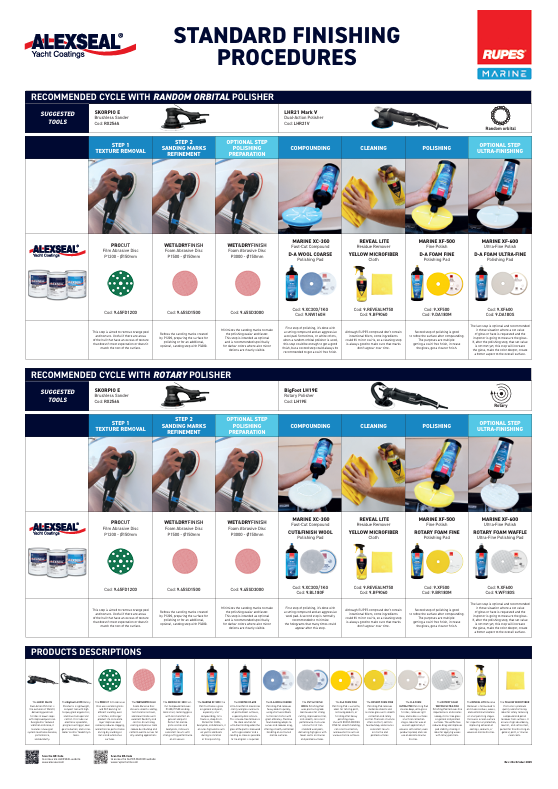
RUPES SpA and ALEXSEAL Yacht Coatings announce a formal cooperation that establishes a shared, standardized procedure for professional finishing operations on coated marine surfaces. This cooperation has been created to bring greater process control and repeatability to a critical phase of yacht construction and refit—where the final visual result depends not only on coating quality, but also on the consistency of surface refinement, sanding progression, residue management, inspection discipline, and polishing choices. In real-world production, even minor differences in step sequence, abrasive selection, pad choice, or cleaning between stages can lead to visible variations in gloss, clarity, and uniformity across large panels; the joint protocol is intended to reduce that variability by defining a clear, verified route to the desired final appearance. The agreement provides a common recommendation that can be adopted across shipyards, refit yards, and applicator teams, supporting stable outcomes even when working conditions, operators, or production timelines vary—while also helping teams communicate more effectively around process checkpoints, quality expectations, and corrective actions when needed.
At the core of this cooperation is a jointly defined “Standard Finishing Procedures” cycle, developed to translate best-practice finishing know-how into a structured method. The protocol is designed as a practical working standard: it clarifies step order, defines the purpose and expected outcome of each phase, and aligns each stage with recommended tools and consumables so that results are measurable and repeatable. Rather than leaving critical decisions to individual habits or local practice, it provides a shared baseline for how to approach refinement and gloss development on coated marine surfaces, including guidance that supports consistent handovers between teams and shifts. In addition, it supports professional training and internal yard standardization by giving supervisors, quality teams, and operators a shared standard process—making it easier to train new personnel, align subcontractors with yard expectations, document procedures, and maintain consistent finishing performance across multiple projects and seasons.
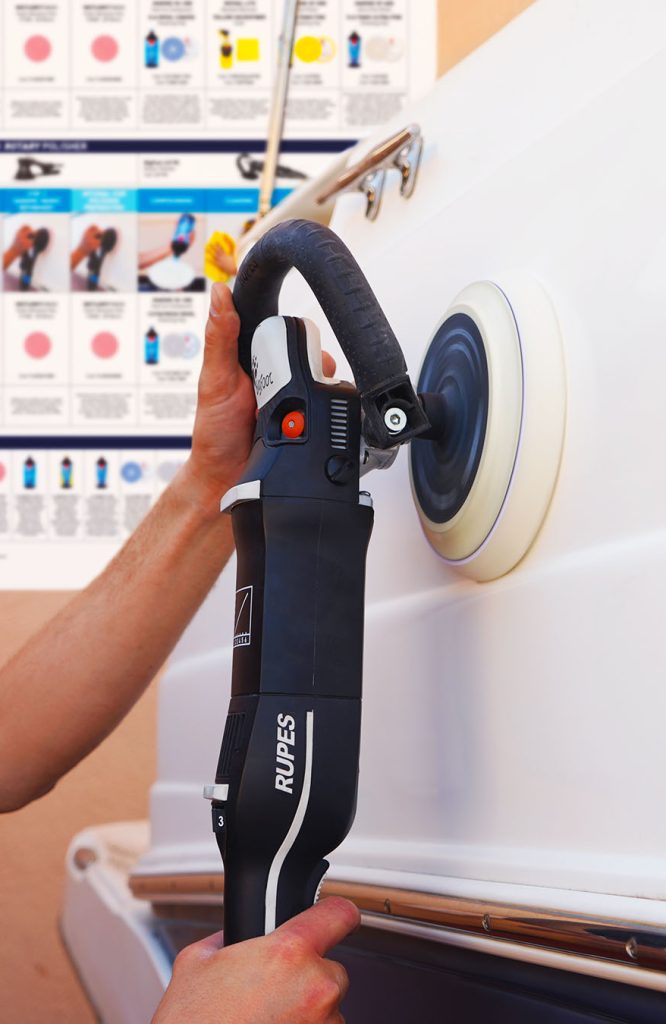
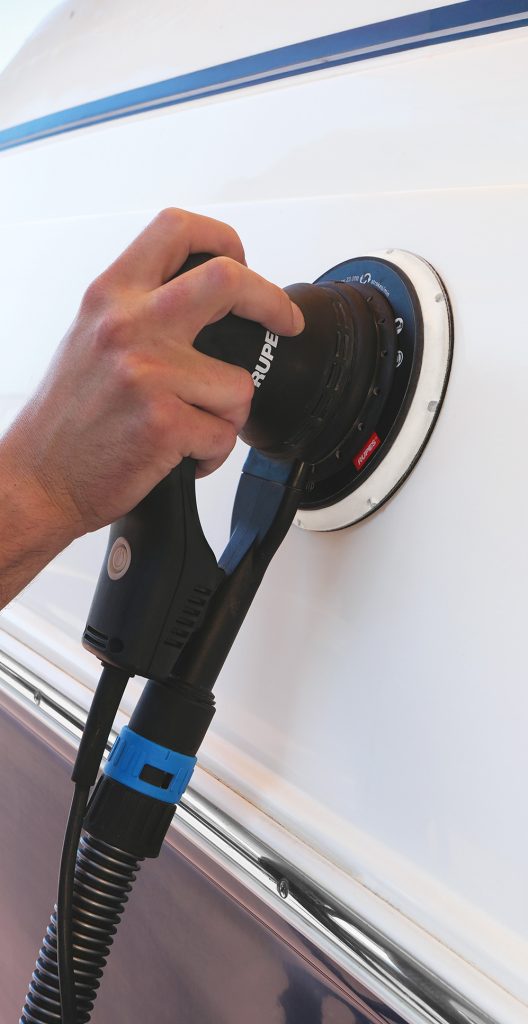
The protocol is presented in two parallel recommended cycles—one for random orbital (dual-action) polishing and one for rotary polishing—so professionals can select the approach that best matches the surface condition, production requirements, and finishing preference while remaining within the same standardized methodology. Importantly, both routes are aligned to the same logic: progressive refinement, controlled defect removal, and disciplined cleaning/inspection between phases to maintain clarity and uniformity.
The procedure covers the complete finishing route from surface leveling to final appearance and is structured to minimize variability while protecting coating integrity. It begins with controlled texture removal, where the objective is to level surface irregularities. It then proceeds through progressive sanding mark refinement, using a defined abrasive progression so each subsequent step removes the trace of the previous one. When needed, a dedicated polishing preparation stage is included to ensure the surface is ready for the compounding phase—helping reduce compound loading, improve cut uniformity, and support clearer results.
From there, the cycle transitions into compounding to remove the refined sanding haze and restore optical clarity, followed by an explicit cleaning and inspection phase that removes residues and allows the operator to verify true surface condition before moving forward. Polishing then develops gloss and depth, targeting higher definition and improved light reflection uniformity across larger panels and complex geometry. Finally, an optional ultra-finishing step is included for premium aesthetic targets—intended to maximize clarity, gloss, and uniformity under demanding lighting conditions and to support the highest standards typically expected on superyacht surfaces.
Across all phases, the shared Standard Finishing Procedures emphasize disciplined step separation, defined materials, and consistent process checks. By aligning abrasives, pads, compounds, cleaning products, and machine types to the role of each stage, the protocol helps reduce “operator-dependent” variation and supports repeatability between different teams and yards—particularly important for large surfaces where consistency must be maintained panel-to-panel and across extended production windows.